How to Calculate Calorie Deficit for Fat Loss
Setting a Safe and Sustainable Calorie Deficit.


Before you can even consider a calorie deficit, you need to know your starting point. That number is your Total Daily Energy Expenditure, or TDEE.
Think of your TDEE as your body's daily energy budget. It's the total number of calories you burn over 24 hours just by living your life. If you eat exactly that many calories, your weight holds steady.
Eat more, and you gain weight. Eat less, you lose it. It really is that simple, and it's the bedrock of any successful fat loss plan.
Finding Your Baseline: BMR and Activity Level
Your TDEE isn't just one thing; it's a combination of:
- Basal Metabolic Rate (BMR): This is your "coma calorie" count. It's the energy your body needs to keep the lights on—powering your heart, lungs, and brain while you're completely at rest.
- Activity Level: This covers every other calorie you burn through movement. We're talking about everything from intense gym sessions and daily walks to fidgeting at your desk and doing the dishes.
The process is straightforward: we'll find your BMR first, then multiply it by a factor that reflects your daily activity. This gives us a solid estimate of your TDEE.
To get that BMR number, we need a reliable formula.
Why We Use Formulas Like Mifflin-St Jeor
While there are a few ways to estimate BMR, the Mifflin-St Jeor equation is widely considered the gold standard for its accuracy. It takes into account your weight, height, age, and sex to give you a personalized baseline.
Once you have that BMR figure, we bring in the activity multiplier. This simple multiplication step transforms your resting calorie burn into a real-world estimate of your total daily energy needs. For a deeper dive into this foundational process, check out the resources at protealpes.com.
Key Takeaway: You can't just guess your calorie deficit. You have to start by calculating your maintenance calories (TDEE). Getting this number right is the single most important step for getting predictable, sustainable fat loss results.
This TDEE number becomes the anchor for your entire strategy. From here, we can confidently create a calorie deficit that's built for your body and your lifestyle.
Figuring Out Your Maintenance Calories With TDEE Formulas
Alright, let's get into the numbers. Don't worry, the math for finding your calorie deficit isn't as scary as it looks. We'll walk through it step-by-step to find your Total Daily Energy Expenditure (TDEE). Think of your TDEE as your "maintenance" number—it's how many calories your body burns in a typical day, and it's the foundation for everything else.
Using The Mifflin-St Jeor Formula in The Real World
Theory is great, but let's make this practical. We'll use a common example to see how the formula works.
- Who: A 35-year-old man
- Height: 5'10" (178 cm)
- Weight: 190 lbs (86 kg)
- Lifestyle: Moderately Active (works a desk job but makes it to the gym 3-4 days a week)
First up, we need his Basal Metabolic Rate (BMR). This is just the baseline number of calories his body burns at complete rest. We'll use the reliable Mifflin-St Jeor formula.
For men, the formula is: BMR = (10 x weight in kg) + (6.25 x height in cm) - (5 x age in years) + 5
Let's plug in his stats:
- BMR = (10 x 86) + (6.25 x 178) - (5 x 35) + 5
- BMR = 860 + 1112.5 - 175 + 5
- BMR = 1802.5 calories
So, if our guy did nothing but stay in bed all day, his body would still burn about 1,803 calories just to keep the lights on. That’s his metabolic baseline.
Going From BMR to TDEE: Add in Your Lifestyle
That 1,803-calorie BMR doesn't account for his actual life—his job, workouts, or even walking the dog. To get his true maintenance calories, we need to multiply his BMR by an activity factor. Since he’s exercising 3-4 days a week, we'll use the "Moderately Active" multiplier, which is 1.55.
The math is simple: TDEE = BMR x Activity Multiplier
- TDEE = 1803 x 1.55
- TDEE = 2795 calories
And there it is. Our 35-year-old, 190 lb man needs roughly 2,795 calories each day just to maintain his current weight. This is his TDEE—the key number we need to create a smart, effective fat loss plan.
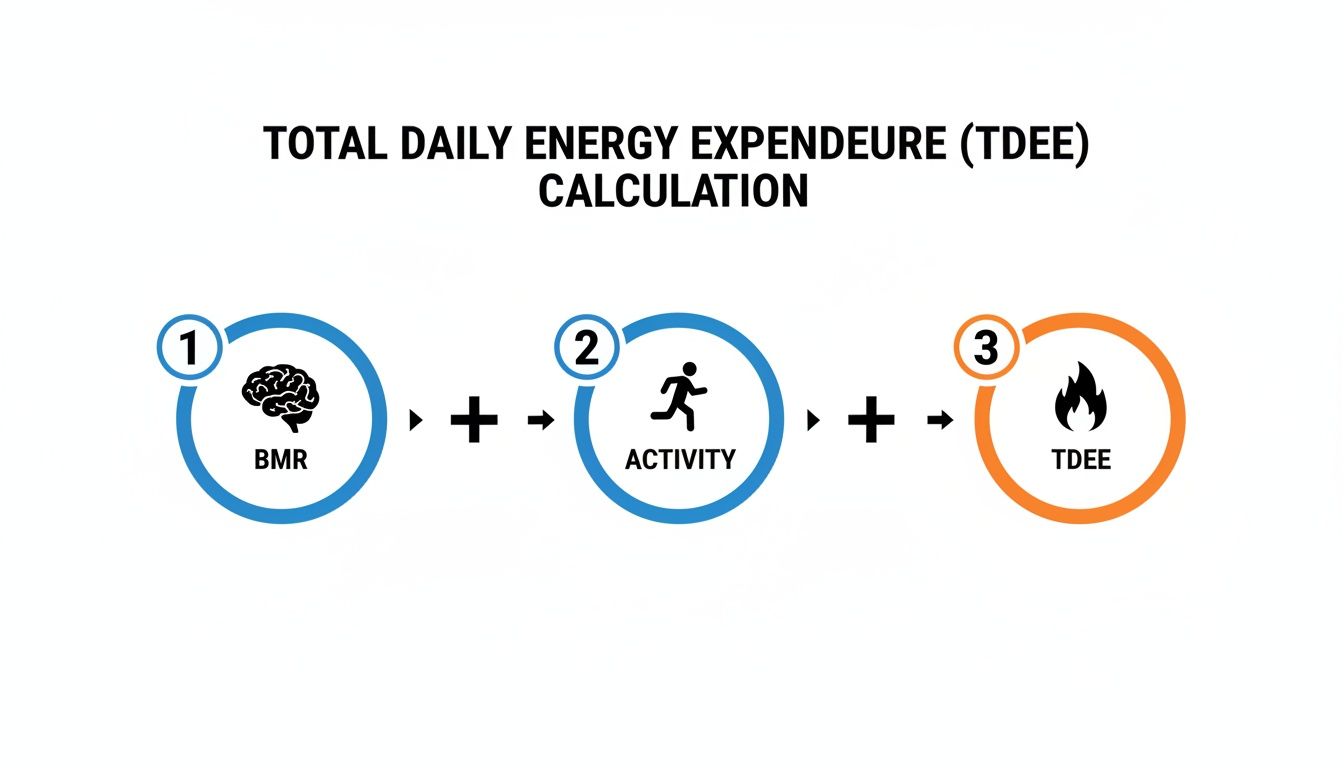
As you can see, your TDEE isn't a fixed number. It's heavily influenced by how much you move every day.
Why Formulas Are a Starting Point, Not a Commandment
It's critical to remember that these formulas, whether it's Mifflin-St Jeor or the older Harris-Benedict equation, are just very good estimates. They give you an excellent, science-backed place to start. But they can't account for everything. Your unique genetics, body composition (how much muscle vs. fat you have), and even your sleep habits can tweak your actual metabolic rate.
Your calculated TDEE is your best-educated guess. Treat it like the starting point on a map. The real work begins once you start tracking your progress and making adjustments based on how your body actually responds.
The Easy Button: Online TDEE Calculators
If you’d rather not do the math by hand, you're in luck. There are plenty of free online TDEE calculators that do all the heavy lifting for you. You just punch in your numbers, and they spit out an estimate using the same trusted formulas. They're a fantastic way to get your starting point in seconds.
Whether you find your TDEE with a calculator or a pencil and paper, the next move is the same: turning that maintenance number into a real plan for fat loss.
Setting a Safe and Sustainable Calorie Deficit
You've done the math and have your Total Daily Energy Expenditure (TDEE)—the number of calories you need to maintain your current weight. Great. Now the real work begins. This next step is where you decide how aggressively you want to chase fat loss, and honestly, it’s the decision that separates long-term success from a frustrating, short-lived diet.
Creating a deficit is simple in theory: eat fewer calories than your TDEE. But how many fewer? This isn't about picking a random number out of thin air. It’s about finding that sweet spot where you’re making progress without feeling miserable.
Moderate vs. Aggressive: The Critical Trade-Off
When you set your calorie target, you're essentially choosing between two paths: the slow-and-steady route or the all-out sprint. Each one has major consequences for your energy in the gym, your mood at work, and whether you actually stick with it.
A moderate deficit is what I recommend for 99% of guys. This means subtracting 300 to 500 calories from your TDEE. For that man we talked about with a TDEE of 2,795, he’d be aiming for a daily intake between 2,295 and 2,495 calories.
- The upside? It’s sustainable. You’ll have more energy for workouts, you’ll hang onto more of your hard-earned muscle, and you won’t feel constantly hungry or irritable. It’s a marathon, not a sprint.
- The downside? Progress feels slower. You might only see the scale drop by 0.5 to 1 pound a week, which takes patience and trust in the process.
On the flip side, an aggressive deficit means a much bigger cut—think 700 calories or more below your TDEE. It’s tempting if you want fast results, but it’s a strategy that almost always backfires.
- The upside? The only real benefit is seeing a bigger drop on the scale in the first couple of weeks.
- The downside? This path is a minefield. You're setting yourself up for serious muscle loss, tanking your energy levels, nutrient deficiencies, and crazy cravings. It can even mess with your testosterone levels and trigger metabolic adaptation, where your body actively fights you by slowing everything down.
For the vast majority of men, a moderate deficit is the smarter, more effective choice. It allows you to build sustainable habits without sacrificing your health, performance, or sanity.
How to Choose Your Deficit
The right number for you really depends on your timeline and goals. A guy getting ready for a wedding in six weeks has a different set of priorities than someone who wants to completely transform their health over the next year.
Let’s look at two common scenarios:
- The Short-Term Goal (like a beach vacation): If you've got a hard deadline a few weeks away, a slightly larger deficit of 500-600 calories might make sense for a very limited time—say, 4 to 6 weeks. You have to accept the trade-offs, like lower energy, for faster results, but you know it’s not forever.
- The Long-Term Lifestyle Change: If your goal is to lose 30 pounds and never see it again, sustainability is king. Starting with a conservative 300-400 calorie deficit is the winning move here. It gives your body and mind time to adapt without feeling like you're on a crash diet.
A good rule of thumb for steady, maintainable progress is a deficit of 500 to 700 calories per day. This usually results in about one pound of fat loss per week. One crucial rule, however, is to never let your daily calories drop below your Basal Metabolic Rate (BMR).
The Danger of Going Too Low
It’s so easy to fall into the trap of slashing calories drastically, thinking it will speed things up. This is a classic fat-loss mistake. Eating too little not only makes you feel awful, but it also signals your body to go into survival mode. It starts preserving body fat and burning your precious muscle tissue for energy instead.
That Old “3500 Calorie Rule”? It’s Not the Whole Story.
You've heard it a million times: cut 3500 calories to lose one pound of fat. It’s been the cornerstone of weight loss advice for decades because it’s simple, clean, and easy to remember.
And while it's a decent ballpark figure to get you started, relying on it too strictly is often why progress grinds to a halt, and frustration sets in. The truth is, your body is far more complex than a simple calculator.
Your Body Is Smart, and It Fights Back
When you consistently eat in a calorie deficit and start losing weight, your body doesn't just go along for the ride. It notices. As you get leaner, your metabolism cleverly adjusts to your new, lighter frame in a process called metabolic adaptation.
Here’s how that actually plays out:
- Your Maintenance Calories Drop: A smaller body simply requires less energy to run. The 190-pound version of you burns more calories just existing than the 175-pound version.
- You Burn Less During Exercise: Your body also gets more efficient. That same 30-minute jog burns fewer calories when you're carrying less weight.
- Your Unconscious Movement Decreases: Your body might even try to conserve energy by reducing small, fidgety movements you don't even notice, like tapping your foot or shifting in your chair (this is known as Non-Exercise Activity Thermogenesis, or NEAT).
Put it all together, and that 500-calorie daily deficit that was working like a charm in week one might effectively be a 350-calorie deficit by week eight—even if your diet and workouts haven't changed one bit.
This is exactly why that old, static 3500-calorie model fails so many people. The relationship between your deficit and your rate of weight loss isn't a straight line. As your body changes, so does your metabolism, and the pace of fat loss naturally slows down. This is well-documented in modern human metabolism research, which shows why dynamic models are far more accurate for predicting long-term results.
How to Break Through the Inevitable Plateau
Understanding metabolic adaptation is the secret to outsmarting the dreaded weight loss plateau. It’s not a signal that you're doing something wrong; it's a sign that your body has successfully adjusted to your new reality.
The Big Picture: A weight loss plateau isn't a failure. It's your body adapting, just as it’s designed to do. Expecting it is half the battle—it lets you make smart adjustments instead of giving up.
So, instead of panicking and slashing another 500 calories from your diet, you can take a more strategic approach. It might be time to recalculate your maintenance calories based on your new, lower body weight. Or, maybe you could add a 15-minute walk to your day to widen that deficit again.
Don't Just Count Calories—Make Your Calories Count
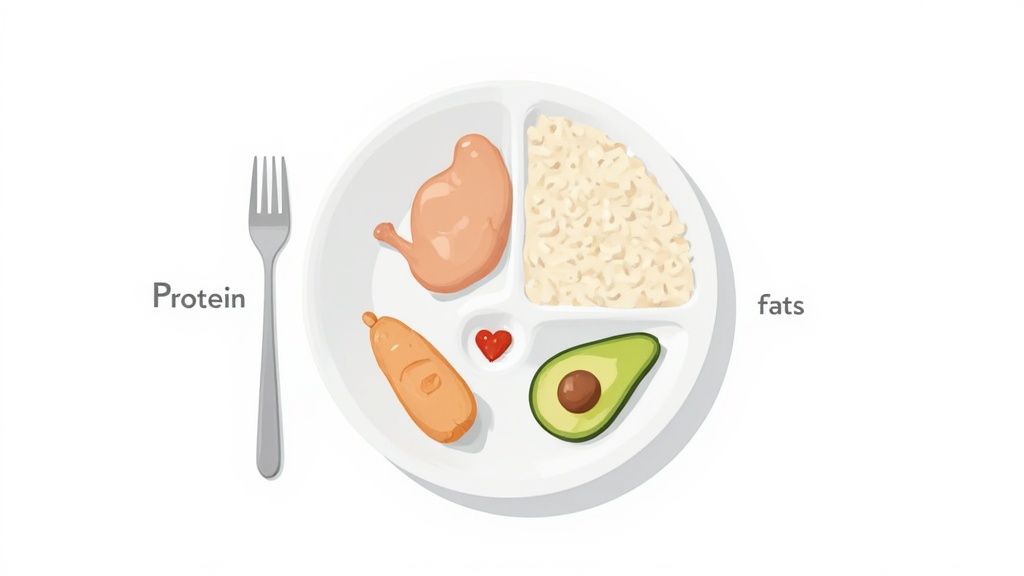
Hitting your daily calorie number is only half the battle. If you want to lose actual body fat while keeping the muscle you've worked for, the quality of those calories is what truly moves the needle. This is where getting smart about your macronutrients comes in.
Thinking about the makeup of your calories—the proteins, carbs, and fats—is the secret to making a calorie deficit work for you, not against you. Understanding what are macronutrients and micronutrients is fundamental to fueling your body correctly.
Out of the big three, one is the absolute king when it comes to fat loss.
Protein: The Foundation of a Successful Fat-Loss Diet
When you’re cutting calories, protein isn't just a good idea; it's a non-negotiable. Seriously. Getting enough of it is the single most important thing you can do to protect your body composition.
Here’s why it’s so essential:
- It Spares Your Muscle: Your body needs amino acids from protein to repair itself. Without enough, it'll start scavenging that protein from your muscles, leaving you weaker and sabotaging your metabolism.
- It Crushes Hunger: Protein is by far the most filling macronutrient. High-protein meals keep you feeling satisfied for hours, which makes sticking to your deficit a whole lot easier.
- It Boosts Your Metabolism: Your body uses more energy to digest protein than it does for carbs and fats. This is called the Thermic Effect of Food (TEF), and it gives you a small but meaningful metabolic advantage all day long.
For active guys in a deficit, a great target is between 1.6 to 2.2 grams of protein per kilogram of body weight. That works out to roughly 0.7 to 1.0 grams per pound. Hitting this range ensures you're giving your body the raw materials it needs to hold onto muscle while the fat comes off.
How to Build Your Plate from a Protein-First Mindset
Once you know your protein target, the rest of your diet becomes incredibly flexible. You can stop agonizing over the perfect carb-to-fat ratio and just fill in the rest of your calories with what you enjoy and what fuels your performance.
- Carbohydrates are your body's go-to energy source, especially for tough workouts. Having some carbs from sources like oats, potatoes, or rice around your training can make a huge difference in your performance.
- Fats are vital for hormone production (hello, testosterone!) and overall health. Just be sure to focus on quality sources like avocados, nuts, olive oil, and seeds.
The strategy is simple: lock in your protein goal first. After that, adjust carbs and fats to fit your lifestyle and how you feel best.
A Pro Tip From Experience: Don't get trapped by "good food vs. bad food" thinking. Focus on hitting your protein and calorie goals with about 80-90% whole, nutrient-rich foods. That leaves you 10-20% wiggle room for other foods you enjoy, which makes the whole process sustainable.
Tying It All Together: A Real-World Macro Example
Let's circle back to our 35-year-old, 190 lb (86 kg) guy. We landed on a target of 2,300 calories per day for his 500-calorie deficit.
Here's how we turn that number into a practical, muscle-preserving meal plan, starting with protein.
- Nail Down the Protein Target: We'll aim for the middle of the range at 1.8g per kg.
86 kg x 1.8 g/kg = 155 grams of protein- Since protein has 4 calories per gram:
155g x 4 kcal/g = 620 calories
- Figure Out What’s Left:
2,300 total calories - 620 protein calories = 1,680 calories remaining
- Split the Rest Between Carbs and Fats: Now he can divide those 1,680 calories based on his preference. A balanced approach might look something like this:
- Carbohydrates (45%):
1,680 x 0.45 = 756 calories, which is 189g of carbs (756 / 4). - Fats (55%):
1,680 x 0.55 = 924 calories, which is 103g of fat (924 / 9).
- Carbohydrates (45%):
This simple math gives him a clear, actionable set of daily targets: 155g protein, 189g carbs, and 103g fat. That’s not just a calorie number; it's a blueprint for effective fat loss.
To visualize how this looks, here is an example breakdown for a 190 lb individual targeting 2,000 calories with a 500-calorie deficit.
Sample Daily Macronutrient Targets for Fat Loss
| Macronutrient | Grams per Day | Calories | Percentage of Total Calories |
|---|---|---|---|
| Protein | 170 g | 680 kcal | 34% |
| Carbohydrates | 165 g | 660 kcal | 33% |
| Fat | 73 g | 660 kcal | 33% |
This table provides a balanced starting point. Remember, these numbers can be adjusted based on your personal preferences and how your body responds. The most important number to hit consistently is your protein goal.
Tracking and Adjusting Your Progress Like a Pro

Think of your initial TDEE calculation as a well-educated guess—it's your starting line, not the finish line. Real, sustainable results come from treating this number as a baseline and then making smart adjustments based on what your body actually does. This is where meticulous tracking becomes your secret weapon.
To make good decisions, you need good data. That means getting friendly with a couple of essential tools.
- A food scale: Honestly, this is non-negotiable. It's the only way to know what 150 grams of chicken or 30 grams of peanut butter truly looks like. Guessing your portions is one of the fastest ways to stall your progress.
- A tracking app: Using an app like MyFitnessPal or Cronometer removes all the mental math from logging meals. You get a clear, objective picture of your daily calories and macros.
Ditch the Daily Scale Drama
Jumping on the scale every single morning can drive you crazy. It's totally normal for your body weight to swing up and down by several pounds day-to-day, thanks to things like water retention, how much salt you ate, or even just normal digestion. This daily "noise" hides your real progress and can be incredibly frustrating.
So, here's the pro move: focus on the weekly average.
Weigh yourself each morning, but do it under the same conditions—right after using the restroom and before you eat or drink anything. Jot down the number, and then just forget about it for the rest of the day. At the end of the week, add up the seven weigh-ins and divide by seven. That average is your true north. Comparing one week's average to the next tells you the real story.
Key Takeaway: Daily weight fluctuations are just noise. The only number that matters for tracking fat loss is your weekly weight average.
When and How to Make Adjustments
Adjusting your calories requires patience and a methodical approach. Don't freak out if the scale is stubborn for a few days. The rule of thumb I give clients is simple: if your weekly average weight hasn't moved down for two consecutive weeks, it might be time for a small tweak.
This doesn't mean you need to slash another 500 calories from your diet. That's a rookie mistake. A small, precise adjustment is usually all it takes.
Try reducing your daily calorie target by just 100–150 calories. Hold this new target for another two weeks and see what happens. This minor change is often just enough to reignite fat loss without sending your hunger and energy levels through the floor.
Before you cut calories, though, play detective. Are you really tracking everything? That splash of creamer in your coffee, the olive oil you cook with, that handful of nuts you grabbed on the way out the door—these "hidden calories" add up fast and can completely wipe out a moderate deficit. Consistent tracking and small, patient adjustments are what separate those who succeed from those who get stuck.
Your Calorie Deficit Questions, Answered
Once you get started, a few questions always seem to pop up. Let's tackle the most common ones I hear from people who are just figuring out their calorie deficit for fat loss.
How Often Should I Recalculate My Calorie Target?
This is a great question. A good rule of thumb is to run your numbers again after every 10-15 pounds you lose.
Why? Because as you get lighter, your body's daily energy needs (your TDEE) actually decrease. Sticking to the same calorie goal without adjusting for your new, lighter weight is a classic reason why fat loss stalls.
You should also recalculate if your lifestyle changes in a big way. Maybe you started a construction job after working at a desk, or you finished a marathon training block and are taking it easy. Any significant shift in daily activity warrants a quick TDEE check-up.
Your TDEE isn't a "set it and forget it" number. Think of it as a dynamic target that needs to be updated as your body changes. This keeps your fat loss journey moving forward.
Can't I Just Exercise More to Create My Deficit?
In theory, yes. In practice, it’s a recipe for burnout and frustration. Relying solely on exercise to create a deficit is incredibly difficult for the average person to sustain. It’s far more efficient to get your nutrition in order first.
Think about it: a tough 30-minute run might burn 300 calories. You could cut the same 300 calories from your diet just by swapping a sugary soda for water or passing on that extra handful of trail mix.
The winning formula will always be a combination of a smart, controlled diet and regular exercise. Let nutrition do the heavy lifting for the deficit, and use exercise to build muscle, improve your health, and burn a few extra calories.
What Happens If My Calorie Deficit Is Too Big?
Pushing your deficit too hard is one of the biggest mistakes you can make. Dropping your calories too low (especially below your BMR) might seem like a shortcut, but it almost always backfires.
Going too aggressively can lead to:
- Significant muscle loss (which tanks your metabolism)
- Constant fatigue and low energy
- Nagging hunger and cravings
- Nutrient deficiencies
- Potential hormonal disruptions
This approach slows your metabolism down, making it much harder to keep the weight off long-term. A moderate, sustainable deficit is always the smarter path.
ActiveMan — Make Your Move
The Modern Guide to Men’s Health, Fitness & Lifestyle.