How to Get Bigger Legs: The Training Plan for Size and Strength
This is a straightforward template you can run for 8–12 weeks.
If you want your physique to look athletic, powerful, and balanced, you can’t skip leg day.
The good news: learning how to get bigger legs isn’t complicated. It’s mostly about training the right movements, doing enough hard sets each week, and progressing them over time.
The bad news: most guys don’t grow their legs because they train them like an afterthought—random machines, half reps, and no plan to add load or reps.
What “bigger legs” really means (and what to train)
Leg size comes from building four major areas:
- Quads (front of thigh): squats, leg press, split squats
- Hamstrings (back of thigh): RDLs, leg curls, hip hinges
- Glutes: squats, hip thrusts, lunges, deadlift variations
- Calves: standing and seated calf raises
If your program is missing one of these, your legs won’t look “complete.”
Step 1: Use enough weekly volume (but recover from it)
Weekly “hard sets” are one of the best predictors of hypertrophy—up to the point where recovery becomes the limiter.
Research syntheses consistently show a dose-response relationship between training volume and muscle growth, with higher weekly sets generally outperforming very low volumes—especially in trained lifters.
A classic meta-analysis found more growth at higher weekly set volumes (10+ sets per muscle) compared to fewer sets, although the exact “best” number varies by person and training status.
For most men trying to figure out how to get bigger legs, a workable target is:
- Quads: 10–16 hard sets/week
- Hamstrings: 8–14 hard sets/week
- Glutes: 8–16 hard sets/week
- Calves: 8–16 hard sets/week
If you’re a newer lifter, start at the low end. If you’re advanced and recovery is strong, build toward the top end.
Step 2: Train legs at least twice per week
Two lower-body sessions per week is a sweet spot for most busy men.
It lets you accumulate enough quality sets without turning leg day into a 2-hour suffering session, and it gives you a second weekly “skill exposure” on big lifts like squats and hinges.
If you can only train legs once weekly, you can still grow—just expect slower progress, and keep the session focused on big compounds plus a few accessories.
Step 3: Get close to failure (with good form)
For hypertrophy, you generally want most working sets taken to about 0–3 reps in reserve (RIR). That means you finish a set knowing you could maybe grind out 1–3 more good reps.
Why it matters: sets that end far from failure often don’t recruit as many high-threshold motor units, especially at moderate loads. In plain English, you’re doing work—but not the kind that forces growth.
That said, don’t chase failure on every set of heavy squats. Use good judgment:
- Compounds (squat/RDL/leg press): stop with 1–3 RIR most of the time
- Accessories (leg curls/extensions, calves): you can push closer to failure safely
Step 4: Prioritize the movements that actually build leg size
If you want the shortest path to bigger legs, your program should revolve around:
The squat pattern (quad + glute)
Back squat, front squat, hack squat, or a hard leg press.
Choose the one that lets you use a big range of motion and progress steadily without joint pain.
The hinge pattern (hamstring + glute)
Romanian deadlifts (RDLs) and similar hinges are money for hamstrings and glutes.
Control the lowering phase. A controlled eccentric (about 2–3 seconds down) is a simple way to increase effective tension without adding junk volume.
The single-leg pattern (balance + extra volume)
Bulgarian split squats, walking lunges, step-ups.
These build legs while also cleaning up side-to-side imbalances.
Direct calf work (because calves don’t “accidentally” grow)
Do both standing and seated variations over the week to hit gastrocnemius and soleus.
The 2-day plan: a simple program for bigger legs.
Schedule it like this:
- Day 1: Lower (quad focus)
- Day 4 or 5: Lower (hamstring/glute focus)
Keep at least 48 hours between lower sessions.
Lower Day 1 (Quad focus)
- Back squat or front squat: 4 sets x 6–10 reps
- Leg press: 3 sets x 10–15 reps
- Bulgarian split squat: 3 sets x 8–12 reps/leg
- Leg extension (optional): 2 sets x 12–15 reps
- Standing calf raise: 4 sets x 8–12 reps
Rest 2–3 minutes on squats/presses. Rest 60–90 seconds on accessories.
Lower Day 2 (Hamstring + glute focus)
- Romanian deadlift: 4 sets x 6–10 reps
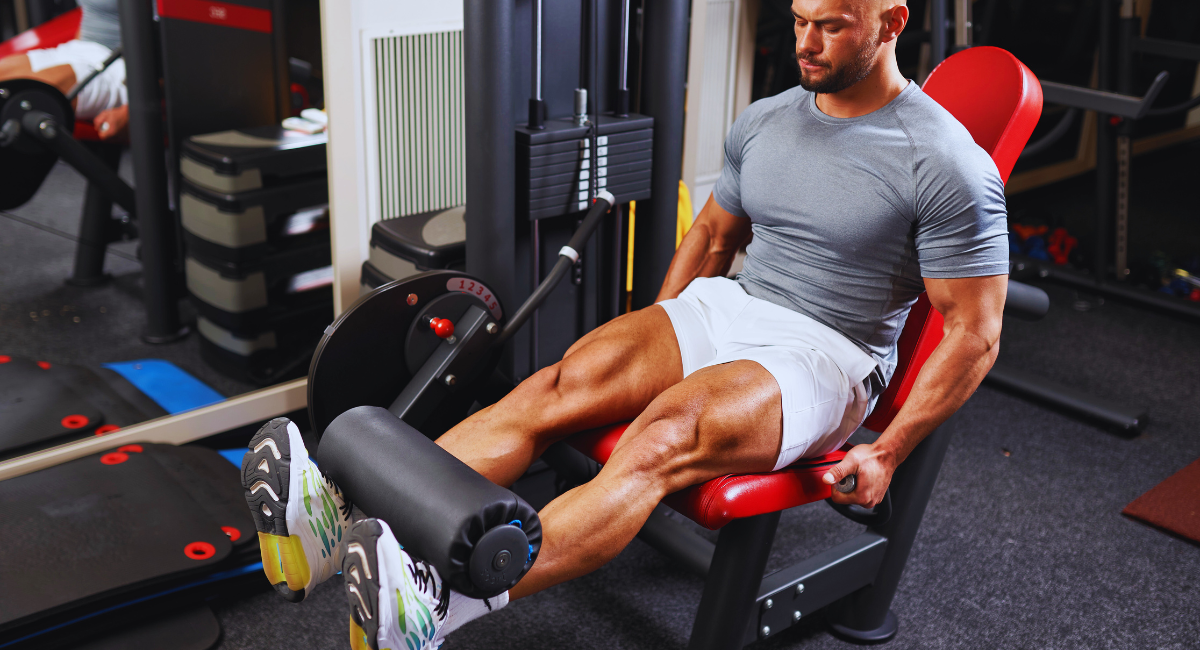
- Lying or seated leg curl: 3 sets x 10–15 reps
- Hip thrust: 3 sets x 8–12 reps
- Walking lunge: 2–3 sets x 10–14 reps/leg
- Seated calf raise: 4 sets x 10–15 reps
If you’re new to hinges, start lighter. The goal is to feel hamstrings loading under control—not to ego lift.
Progression: the rule that makes your legs grow
The best leg program in the world fails without progression.
Use a simple “double progression” system:
- Pick a rep range (example: 6–10).
- Keep the same weight until you hit the top of the range on all sets.
- Then add 5–10 lb next week (or the smallest jump available) and repeat.
For machines and calves, smaller jumps are fine. For split squats and lunges, adding reps often works better than big weight jumps.
Common mistakes that stop leg growth
Doing “hard” workouts without measurable overload
Sweat isn’t progression. Track your lifts.
Cutting depth and range of motion
Half reps usually mean half stimulus. Use a range of motion you can control and repeat.
All quads, no hamstrings (or vice versa)
Big quads with weak hamstrings is a recipe for knee issues and an unbalanced look.
Never training calves directly
Calves often need more direct work than you think. Treat them like a muscle group, not an afterthought.
Nutrition for bigger legs (you can’t out-train under-eating)
If your goal is bigger legs, you need to give your body building materials.
Calories: slight surplus works best
For most men, a small calorie surplus (roughly +200 to +300/day) supports muscle gain with minimal fat gain.
Protein: hit a realistic daily target
A widely cited meta-analysis suggests diminishing returns above roughly 1.6 g/kg/day of protein, with an upper confidence interval around 2.2 g/kg/day. Practically, aiming for 1.6–2.2 g/kg/day is a strong range for hypertrophy-focused training.
If you want an easy rule: most active men do well with about 0.7–1.0 grams of protein per pound of body weight.
Carbs: don’t fear them if you want bigger legs
Hard leg training runs on glycogen. If your carbs are too low, performance often drops—then volume and progressive overload drop right behind it.
Recovery: the unsexy part of how to get bigger legs
Legs grow when you recover from training, not while you’re doing it.
- Sleep: aim for 7–9 hours most nights
- Steps/cardio: keep it consistent, but don’t turn every day into a marathon while trying to grow
- Deloads: every 6–10 weeks, reduce volume by ~30–50% for one week if joints and fatigue build up
Want to build bigger legs faster? Add these “finisher” options (optional)
Use these sparingly—only if recovery is good and your main lifts are progressing.
- Leg press back-off set: 1 set of 15–25 reps at a lighter weight
- Walking lunge density set: 5 minutes continuous, short breaks as needed
- Calf pump set: 1 set of 20–30 reps after your heavier calf work
Internal tip: train legs like you train everything else
If you’re serious about how to get bigger legs, treat your leg sessions like your bench press or biceps:
Pick a plan, track numbers, repeat it long enough to progress, then adjust.
FAQ: How to get bigger legs
How long does it take to get bigger legs?
Most men notice visible changes in 8–12 weeks if training and nutrition are consistent. Bigger transformations typically take 6–12 months.
How many days a week should I train my legs for size?
Two days per week works well for most men. Advanced lifters may add a third lighter session, but only if recovery stays strong.
Should I squat or leg press for bigger legs?
Both work. Squats build skill and total-body strength; leg press can add quad volume with less technique limitation. Many lifters grow best using both.
How heavy should I lift to build bigger legs?
Use loads that keep you mostly in the 6–15 rep range on compounds and 10–20 on accessories, taken close to failure with good form.
Why won’t my calves grow?
Most guys don’t train calves hard enough or through full range of motion. Hit calves 2–3 times per week, use both standing and seated raises, and progress them like any other lift.
Conclusion: your next steps
If you want bigger legs, you need a repeatable system: two focused leg days, enough weekly sets, sets taken close to failure, and steady progression.
Start this week: run the two-day plan for 8 weeks, track every working set, and add reps or weight every session you can. Pair it with adequate protein and sleep, and your legs will have no choice but to grow.
ActiveMan — Make Your Move
The Modern Guide to Men’s Health, Fitness & Lifestyle.