
Arm Exercises at Home: Build Bigger Arms Fast

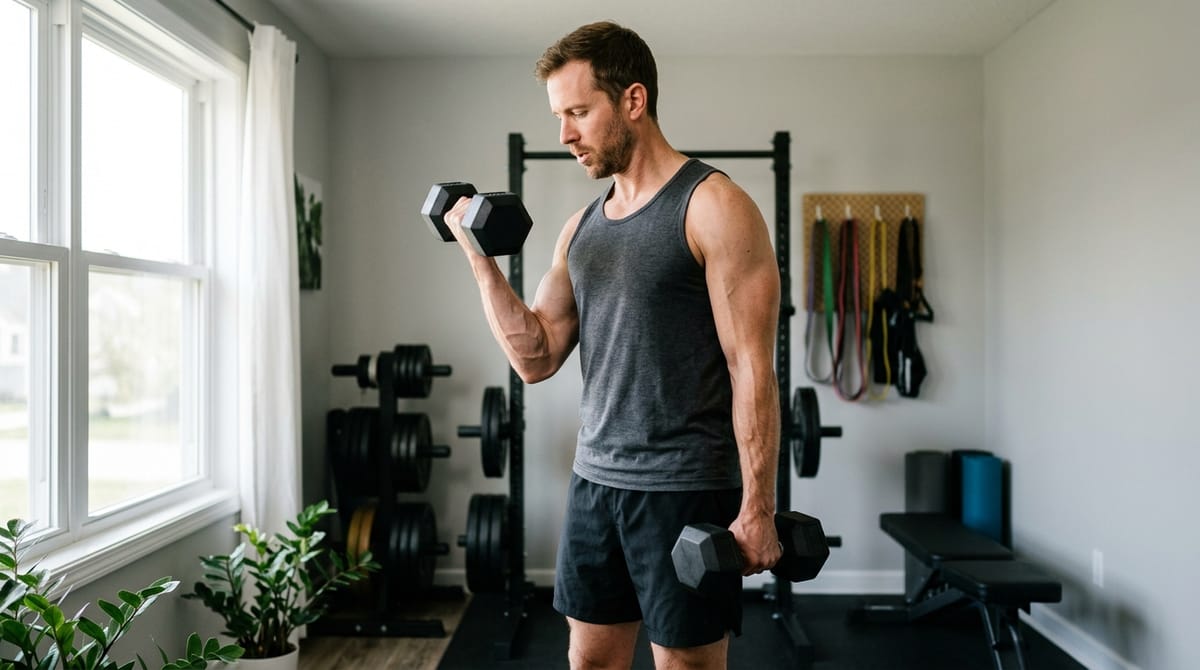
Arm exercises at home can build real size and strength — not just a quick pump. With the right movements, consistent effort, and a clear progression plan, you can grow your biceps, triceps, and forearms without setting foot in a gym.
You do not need machines. Bodyweight moves, resistance bands, dumbbells, and household items all create the mechanical tension required for muscle growth and strength gains.
This guide covers the best arm exercises at home, how often to train, how to make light weights effective, and a simple workout you can start this week.
The Best Way to Train Your Arms at Home
Most men overfocus on curls. That is a mistake. If you want bigger upper arms, you need to train both the biceps and triceps, plus enough forearm work to improve grip and overall arm thickness.
A strong home arm training plan should include:
- Biceps work for elbow flexion and peak contraction
- Triceps work for mass and pressing strength
- Forearm work for grip strength and lower-arm size
- Hard sets close to failure to make lighter loads count
- Progressive overload through reps, tempo, pauses, or added resistance — see the ACSM position stand on resistance training for progression principles.
The best arm exercises at home are not random burnout moves. They train through a full range of motion and give you a clear path to improve over time.
How Often Should You Train Arms at Home?
For most men, direct arm training 2 to 3 times per week produces solid results. If your arms lag behind your chest or back, add a few targeted sets at the end of upper-body sessions.
A practical weekly target is 10 to 16 hard sets for biceps and 10 to 16 for triceps. If your equipment is limited, take sets very close to failure and control the tempo on every rep.
Best Arm Exercises at Home for Size and Definition
You do not need twenty movements. You need a short list of home arm exercises that cover different muscle functions and are easy to progress week over week.
1. Close-Grip Push-Ups
Close-grip push-ups are one of the most effective arm exercises at home because they load the triceps hard while also training the chest and shoulders. Keep your hands just inside shoulder width and your elbows tucked close to your sides.
To increase difficulty, slow the lowering phase to 3 to 5 seconds, pause at the bottom, or elevate your feet on a chair.
2. Chair or Bench Dips
Chair dips add serious triceps volume with zero equipment. They work best for moderate to high reps with full control through the range of motion.
Lower until you feel a strong stretch in the triceps, then press back up. If your shoulders feel irritated, reduce the range or substitute another triceps movement.
3. Dumbbell Curls
Dumbbell curls remain a staple biceps exercise at home for good reason. They train the biceps through a clear range of motion and are easy to track from session to session.
Use strict form, avoid swinging, and squeeze hard at the top. Even light dumbbells build muscle when you use controlled reps and push close to failure — follow a dumbbell progression plan to keep adding reps or weight over time.
4. Hammer Curls
Hammer curls target the brachialis and brachioradialis, two muscles that add visible thickness to the arm. If you want arms that look fuller from every angle, keep these in your weekly plan.
Keep your palms facing each other and your upper arms still throughout each set.
5. Resistance Band Curls
Band curls are among the most practical arm exercises at home because bands are affordable, portable, and easy to progress by increasing reps or switching to a thicker band.
Stand on the band, curl with control, and squeeze hard at the top. They work especially well as a high-rep finisher at the end of a session.
6. Overhead Triceps Extensions
Overhead extensions train the long head of the triceps, which contributes significantly to upper-arm size. You can use a single dumbbell, a resistance band, or a loaded backpack.
Keep your elbows pointed forward and lower the weight under full control. Do not rush the stretch at the bottom — that range is where the long head gets the most stimulus.
7. Band Triceps Press-Downs
With a band and a secure anchor point, you can replicate a cable press-down at home. This is one of the easiest ways to isolate the triceps without heavy equipment.
Lock out each rep fully and pause briefly at the bottom to keep constant tension on the muscle.
8. Underhand Inverted Rows
Underhand inverted rows are primarily a back exercise, but they also challenge the biceps significantly. With a secure setup — a sturdy table or low bar — they are one of the best bodyweight pulling options for arm development.
Pull your chest up to the bar, keep your body straight, and lower slowly on every rep.
9. Towel Curls and Isometric Holds
No weights at all? A towel still works. Step on the towel and curl upward while pulling against your own leg resistance. Add a hold at the midpoint or top for extra time under tension.
Isometric holds are especially useful when equipment is limited because they let you generate high muscular effort without any external load.
10. Wrist Curls and Reverse Wrist Curls
Forearm training matters if you want complete arm development. Wrist curls and reverse wrist curls improve grip strength, support heavier pulling work, and add lower-arm size that most men overlook.
Use dumbbells, bands, or water jugs. Higher rep ranges — 15 to 25 — tend to work best for forearm exercises.
How to Make Home Arm Workouts More Effective
The main challenge with home training is limited load. The solution is straightforward: make each rep harder, not just longer.
Use a Slower Tempo
Lower the weight over 3 to 5 seconds. A controlled eccentric phase increases time under tension and makes light resistance feel significantly heavier on the target muscle.
Train Close to Failure
Easy sets do not drive much growth. For most arm exercises at home, aim to finish each set with 0 to 2 reps left in reserve.
Add Pauses at Peak Contraction
Pause at the top of curls or at full extension on triceps work. A brief pause removes momentum and forces the muscle to stay engaged through the hardest part of the rep.
Increase Range of Motion
A deeper stretch can make basic exercises significantly more effective. Let overhead extensions reach full stretch at the bottom and avoid cutting your curls short at the top.
Use Mechanical Drop Sets
Start with the hardest version of a movement, then immediately switch to an easier variation with no rest. Example: strict dumbbell curls, then hammer curls, then band curls.
This is one of the fastest ways to make arm exercises at home feel demanding without adding more weight.
A Simple Arm Workout You Can Do at Home
If you want a structured plan instead of guesswork, start here. This workout uses dumbbells and bands, but each move has a straightforward no-equipment alternative listed below.
Home Arm Workout A — Dumbbells and Bands
- Close-grip push-ups — 4 sets of 8 to 15 reps
- Dumbbell curls — 4 sets of 10 to 15 reps
- Overhead triceps extensions — 3 sets of 10 to 15 reps
- Hammer curls — 3 sets of 10 to 12 reps
- Band press-downs — 3 sets of 15 to 25 reps
- Wrist curls or reverse wrist curls — 2 to 3 sets of 15 to 20 reps
Rest 45 to 75 seconds between sets. If the load is light, shorten rest periods and push the final reps hard toward failure.
No-Equipment Arm Workout Option
- Close-grip push-ups — 4 sets near failure
- Chair dips — 3 sets of 12 to 20 reps
- Towel curls — 4 sets of 12 to 20 reps
- Isometric curl holds — 3 rounds of 20 to 30 seconds
- Reverse plank or grip holds — 3 rounds for time
Run either workout twice per week and log your reps every session. The goal is simple: do more over time. That is progressive overload in its most practical form.
Common Mistakes with Arm Exercises at Home
Home workouts can build serious arms, but only if you avoid the mistakes that stall progress for most men.
Going Too Light Without Training Hard
Light resistance is not the problem. Low effort is. If the load is light, compensate with stricter form, more reps, slower tempo, and shorter rest periods between sets.
Only Training Biceps
Triceps make up roughly two-thirds of your upper arm. Neglecting triceps is the single biggest reason home arm training stalls. Balance your biceps and triceps volume every week.
Using Sloppy Momentum
Swinging through curls shifts tension away from the biceps and onto the shoulders and lower back. Keep every rep controlled and honest — especially when the weight feels light.
Changing Exercises Every Week
You do not need endless variation. Keep the same core arm exercises at home for 6 to 8 weeks and focus entirely on progression before rotating movements.
Ignoring Recovery
Your arms grow between sessions, not during them. Get enough sleep, hit your daily protein target, and allow adequate recovery time before your next hard arm workout.
FAQ: Arm Exercises at Home
Can you build big arms with arm exercises at home?
Yes. You can build bigger arms at home if you train consistently, challenge both biceps and triceps with hard sets, and apply progressive overload over time. Bands, dumbbells, and bodyweight exercises all produce real results when effort is high.
What are the best arm exercises at home without weights?
The most effective no-weight options are close-grip push-ups, chair dips, towel curls, isometric holds, and underhand inverted rows. These movements cover both biceps and triceps without any equipment.
How many times a week should I do arm exercises at home?
Most men do well with direct arm training 2 to 3 times per week. That frequency gives you enough stimulus to improve without compromising recovery between sessions.
How long does it take to see results from arm exercises at home?
Many men notice improved strength, better muscle tone, and higher rep performance within 4 to 6 weeks. Visible size gains typically take longer and depend on training quality, protein intake, sleep, and current body fat levels.
Do push-ups count as arm exercises at home?
Yes. Close-grip push-ups are especially effective because they place significant load on the triceps while also training the chest and shoulders — making them one of the most efficient bodyweight arm exercises available.
What equipment helps most with arm exercises at home?
Adjustable dumbbells and a set of resistance bands give you the most flexibility for home arm training. If your budget is limited, bands alone can cover biceps, triceps, and forearm work effectively.
Arm exercises at home do not need to be complicated. Pick a handful of proven movements, train with genuine effort, and add reps or resistance over time. That is how you build arms that look stronger and perform better.
Start with the workout above, run it consistently for the next several weeks, and log every session. For more direct training guides built for men who take their fitness seriously, explore more from ActiveMan.
ActiveMan — Make Your Move
The Modern Guide to Men’s Health, Fitness & Lifestyle.


