
At Home Tricep Workouts for Bigger, Stronger Arms

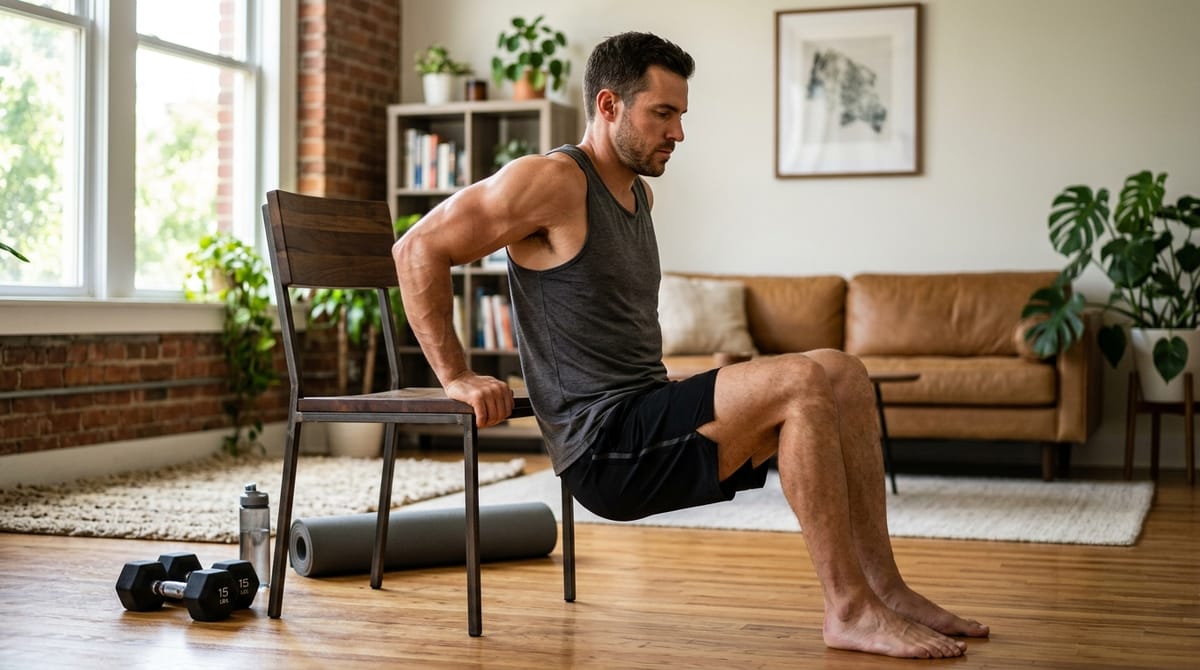
At home tricep workouts can build stronger, fuller-looking arms without a gym membership. Since the triceps make up roughly two-thirds of your upper arm, they drive arm size, push-up strength, and pressing power more than most men realize.
The good news: you can train them effectively with bodyweight, dumbbells, or resistance bands. A smart plan does not need much equipment. It needs the right exercises, clean form, and steady progression.
If your arms are lagging or your home workouts feel too chest-heavy, this guide will help. Below, you will find the best exercises, how to structure effective at home tricep workouts, and the mistakes that most often slow progress.
Why At Home Tricep Workouts Work
The triceps respond well to moderate loads, higher reps, and controlled tempo. That makes them a strong fit for home training, where you may not have machines but can still create plenty of mechanical tension.
Your triceps have three heads: the long head, lateral head, and medial head. Balanced at home tricep workouts should include pressing, elbow extension, and overhead work to train the muscle from multiple angles.
Benefits of Training Triceps at Home
Home tricep training is efficient and easy to stay consistent with. You can add it to push day, use it as an arm finisher, or build a short standalone session around it.
Well-planned tricep exercises at home can help you:
- Build upper-arm size and definition
- Improve lockout strength for presses and push-ups
- Train hard with minimal equipment
- Stay consistent when time or access is limited
- Get more from short home training sessions
The Best Exercises for At Home Tricep Workouts
You do not need a long exercise list. You need a few proven movements that cover bodyweight, dumbbell, and band options. These are the staples worth keeping in your rotation.
1. Close-Grip Push-Ups
This is one of the most reliable bodyweight tricep exercises you can do. By bringing your hands just inside shoulder width and keeping your elbows closer to your sides, you shift more work away from the chest.
How to do it: Start in a plank. Place your hands just inside shoulder width, brace your core, and lower with control. Press back up without letting your elbows flare wide.
Why it works: It builds strength through a compound movement pattern and is easy to progress with added reps, pauses, or a slower lowering phase.
2. Bench or Chair Dips
Dips can add serious tricep volume at home using a sturdy bench, chair, or couch edge. Keep your torso upright and close to the support, and lower only as far as your shoulders feel comfortable.
Why it works: It delivers a strong contraction at the top and works well for higher-rep sets that build endurance and size.
If bench dips bother your shoulders, skip them. Substitute close-grip push-ups, band pressdowns, or dumbbell extensions instead.
3. Overhead Dumbbell Tricep Extensions
If you have one or two dumbbells, this move belongs in most at home tricep workouts. The overhead position places the long head under a deeper stretch, which is key for full tricep development.
How to do it: Hold one dumbbell overhead with both hands. Keep your elbows pointed forward, lower the weight behind your head, then extend back up under control.
Why it works: It is one of the best home options for direct tricep growth and straightforward progressive overload.
4. Dumbbell Skull Crushers
Lie on the floor or a bench and lower the dumbbells toward your forehead or just behind your head. Keep your upper arms still and let the elbows do the work throughout each rep.
Why it works: Skull crushers are excellent for adding focused tricep volume without needing much space or heavy loads.
5. Tricep Kickbacks
Kickbacks are often dismissed because the load is lighter, but strict reps make them genuinely effective. Hinge at the hips, keep your upper arm fixed and parallel to the floor, and extend fully at the elbow.
Why it works: It is a strong finisher when heavier loading is limited and you want direct burn at the end of a session.
6. Resistance Band Pressdowns
If you have bands and a secure anchor point, pressdowns are one of the best cable replacements for home tricep training. Keep your elbows pinned near your sides and press until your arms are fully straight.
Why it works: Bands maintain tension on the triceps through the full range of motion and tend to feel joint-friendly compared to free weights.
7. Diamond Push-Ups
This push-up variation increases tricep demand with a narrower hand position. It is harder than a standard close-grip push-up, so elevate your hands on a surface if needed to manage difficulty.
Why it works: It is a challenging bodyweight option and a strong finisher in more advanced at home tricep workouts.
How to Build Effective At Home Tricep Workouts
The biggest mistake in home arm training is doing random high reps until you feel a burn. That can feel productive, but results come from structure, not guesswork.
A simple setup works best: use one compound movement, one overhead exercise, and one isolation move. That gives you a strong mix of load, stretch, and direct fatigue across all three heads.
Option 1: Bodyweight At Home Tricep Workout
- Close-grip push-ups: 4 sets of 8–15
- Bench or chair dips: 3 sets of 10–15
- Diamond push-ups: 2–3 sets close to failure
This is a reliable no-equipment tricep workout when you want effective training with minimal setup time.
Option 2: Dumbbell At Home Tricep Workout
- Close-grip push-ups: 3 sets of 10–15
- Overhead dumbbell tricep extensions: 4 sets of 8–12
- Dumbbell skull crushers: 3 sets of 10–15
- Tricep kickbacks: 2–3 sets of 12–20
This version gives you a strong balance of compound work, stretch-based tension, and high-rep finishers for complete tricep development.
Option 3: Band-Based At Home Tricep Workout
- Close-grip push-ups: 3 sets of 8–15
- Resistance band pressdowns: 4 sets of 12–20
- Overhead band tricep extensions: 3 sets of 12–20
Band-based at home tricep workouts are a smart choice if you want fast setup, smooth resistance curves, and less joint stress on the elbows.
How Often Should You Train Triceps at Home?
Most men do well with direct tricep work 2 to 3 times per week, depending on how much chest and shoulder pressing they already do in their routine.
A good starting point is 6 to 10 direct sets per week. If triceps are a weak point and recovery is solid, you can build toward 10 to 14 quality sets spread across the week.
How to Make At Home Tricep Workouts More Effective
You do not need better equipment to keep progressing. You need better execution. A few targeted adjustments can make at home tricep workouts significantly more productive.
Use Slower Eccentrics
Lower each rep over 2 to 4 seconds. This increases time under tension and makes lighter weights feel much more demanding on the muscle.
Pause in the Stretched Position
On overhead extensions and skull crushers, pause briefly at the bottom of each rep. This eliminates momentum and forces the triceps to handle more of the workload.
Train Close to Failure
For muscle growth, most working sets should end with only 1 to 3 reps left in reserve. If every set feels easy, your triceps have little reason to adapt and grow.
Track Reps and Progression
Progressive overload applies just as much at home as in a gym. Add reps, improve control, increase resistance, or shorten rest periods over time.
Example: if you hit 10 strong reps on overhead extensions this week, aim for 11 or 12 next week before increasing the load.
Finish the Lockout
The triceps are responsible for full elbow extension. Squeeze hard at the top of each rep instead of bouncing through the final range of motion.
Common Mistakes That Limit Tricep Growth at Home
Even solid at home tricep workouts can fall flat if your form or exercise selection is off. These are the most common mistakes to watch for.
Letting the Chest Take Over
If your elbows flare too wide on push-ups or dips, your chest and shoulders dominate the rep. Keep your arms closer to your sides when the triceps are the primary target.
Using Sloppy Range of Motion
Half reps can make a set feel intense, but they often leave results on the table. Use the fullest pain-free range you can control on every rep.
Repeating Only One Movement Pattern
If your routine is only dips or only push-ups, you are missing useful training angles. The best at home tricep workouts combine pressing, overhead work, and direct elbow extension exercises.
Ignoring Recovery
Triceps handle volume well, but they also work hard during chest and shoulder training. If your elbows feel sore or your pressing is stalling, your total weekly workload may be too high.
FAQ: At Home Tricep Workouts
Can at home tricep workouts build muscle?
Yes. At home tricep workouts can absolutely build muscle when your sets are challenging, your weekly volume is sufficient, and you keep progressing through reps, tempo, or added resistance over time.
What is the best tricep exercise to do at home?
Close-grip push-ups are one of the best all-around choices because they are accessible, effective, and easy to progress. If you have dumbbells, overhead tricep extensions are also excellent for targeting the long head.
How many times a week should I do at home tricep workouts?
Most people see strong results training triceps 2 to 3 times per week. Adjust total volume based on your recovery and how much pressing work you already do in your program.
Do I need dumbbells for effective at home tricep workouts?
No. Bodyweight and resistance bands are enough for effective tricep training at home. Dumbbells simply provide more loading options and make isolation exercises easier to progress.
Why are my triceps not growing from home workouts?
The most common reasons are stopping sets too far from failure, using too little weekly volume, repeating the same easy exercise without progression, or rushing reps with poor form and momentum.
Final Take
You do not need a commercial gym to build better arms. The right at home tricep workouts deliver real results when you focus on smart exercise selection, strong form, and steady progression week over week.
Start with a few proven moves, train your triceps 2 to 3 times per week, and track your reps. Consistency beats complexity, especially when your setup is simple and your time is limited.
If you want bigger arms, stronger lockout strength, and more productive home sessions, add one of these at home tricep workouts to your weekly routine and commit to it for the next month. The results will follow.
ActiveMan — Make Your Move
The Modern Guide to Men’s Health, Fitness & Lifestyle.


